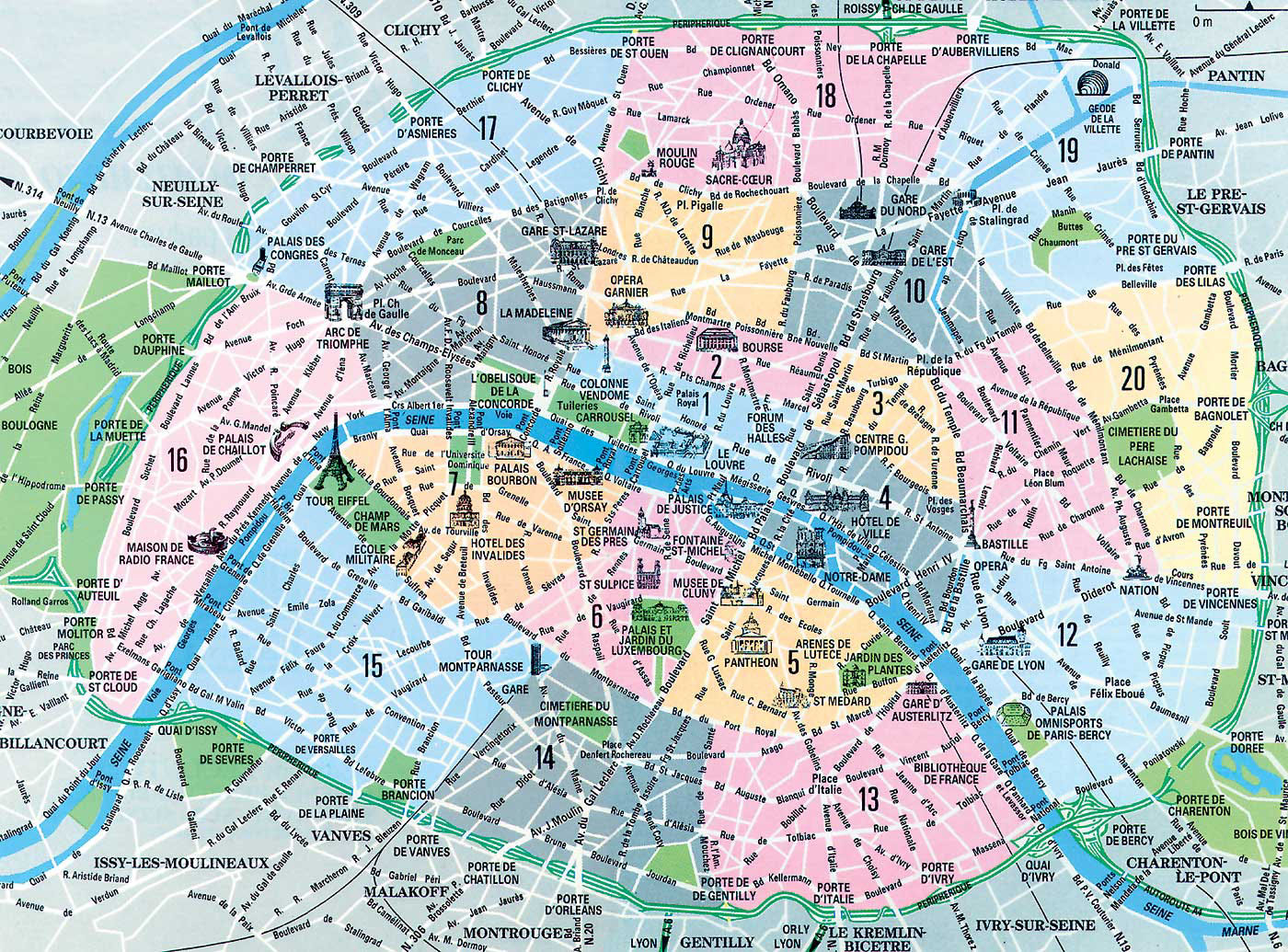
Just a few bits and pieces to – hopefully – make understanding the city a little easier, and have the necessary info at your fingertips …
Where we are

Paris is the capital city of France, in the Department of France, in the Île-de-France region, and sits on the river Seine. The population, of approximately 12 million, speaks French, and many speak English (but don’t take this for granted!).
The time zone is Central European Time (CET), which is Greenwich Mean Time (GMT) +1. Daylight savings runs from the last Sunday in March to the last Sunday in October (clocks are put forward 1 hour during this time). The telephone area code for Paris is 01, France is +33.
The official national weather bureau is Meteo France.
Paris is also known as the City of Lights.
Official sites

The City of Paris site provides plenty of information and an events newsletter: paris.fr
The city’s official tourism site also has plenty of useful information and an events newsletter: parisjetaime.com and they operate physical centres at the Hôtel de Ville (Paris City Hall, in the 4th) and the Gare du Nord (the North Train Station, in the 10th).
There is more information specifically for tourists at Paris Tourist Information: paristouristinformation.fr
And a government tourism agency offering guided tours of lesser-known Paris places – in French and English – is Explore Paris
Emergencies

The European Emergency Number is 112. In Paris, Fire is 18, Police is 17, Ambulance is 15. But if you are having any emergency, just call 112.
An ambulance will take you to the nearest emergency department, and if you are looking for a specific hospital or service you can browse all the facilities at the AP-HP Foundation website.
For English Medical Services, call +33 (0) 1 47 07 77 77. SOS Medecins operate medical centres across the city and offer emergency home visits.
The Préfecture de Police is responsible for law and order, and there are stations all over the city. (Note the police’s navy blue uniforms and ‘Police Nationale’ insignia.)
A green cross denotes a pharmacy (chemist).
For extreme weather alerts, see the Vigilance site.
Also see tourist advice on the Paris je t’aime website.
Public Holidays

1 January: New Year’s Day. Easter Monday [Date varies across late March and early April]. 1 May: Labour Day. 8 May: Victory 1945. Ascension Thursday [Date varies, 40 days after Easter Sunday]. Whit Monday [Date varies, 50 days after Easter Sunday]. 14 July: Bastille Day. 15 August: Assumption. 1 November: All Saint’s. 11 November: Armistice. 25 December: Christmas.
Also note the French school holidays, which you can easily find of the Public Service site (Paris is in department 75).
Transport

Paris has two main airports: the Charles de Gaulle (or Roissy), 25km north-east of Paris, and Paris-Orly, 14km south of Paris in Orly. A third, Paris-Le Bourget, is for business and charter flights. Both main airports are serviced by public transport and taxis.
The Bonjour RATP website and app is a handy transport guide to the city and details transport to and from the airports. Also note that there are strict rules around taxi fares from the airports, so avoid the unofficial operators.
Public transport in Paris is very convenient and there are stations within walking distance all over the city. The RATP manages the city’s RER (the Réseau Express Régional), which connects the inner city to the outer suburbs and airports), the Metro (inner-city trains), buses, trams and the cableway (which runs through the outer suburbs) – see Paris Metro and RER and use the Paris metro map. The Metro train stations are easily identified by the ‘Metro’ or ‘Metropolitan’ signage. The Île-de-France Mobilités app offers daily, weekly or monthly tickets on your phone.
Taxis are available – check the fee and payment method with your driver before you get into the cab. Uber is also widely available. Google Maps is generally reliable, and Citymapper is a widely used European maps site. Paris is also bicycle-friendly, with many safe bike lanes, see the Bicycle Plan and Map and the Vélib bicycle hire. You can also use the Funiculaire de Montmartre to go up and down Montmartre hill, but it is more a tourist attraction than a mode of transport.
News

Le Monde is probably the most widely recognised newspaper (and online format) in France. You also have Le Monde Diplomatique, Le Parisien, 20 Minutes, Charlie Hebdo, France 24, Le Canard Enchainé, Le Gorafi (satirical) L’Equipe L’Humanité, Les Echos, Liberation and Mediapart.
Radio

Yes, the Eiffel Tower is also a radio transmitter. You can access hundreds of radio stations in Paris including Radio France Internationale (French news and current affairs public radio station that broadcasts worldwide in French and in 16 other languages), World Radio Paris (English-speaking from within Paris) and Paris Underground Radio (English-speaking podcasts from within Paris).
Money

The national currency is the Euro. The National Bank is the Banque de France. Note most businesses accept card transactions, but small businesses (and markets) often prefer cash. There are many banks throughout the city, most offering ATMs (distributeur automatique de billets or DABs), which you can also find in post offices. You can locate ATMs through their owner sites such as: BNP Paribas, Crédit Agricole, La Banque Postale and Société Générale.
Language

French people don’t necessarily expect visitors to speak French, but do appreciate you giving it a go (they will help you if you show some respect and politeness – much like everywhere). Keep a few key phrases up your sleeve to begin a conversation, and quickly let them know you don’t speak French if you don’t!
Hello: Bonjour. Good evening: Bonsoir. Goodbye: Au revoir. Thank you: Merci. Thank you very much: Merci beaucoup. Excuse me: Excusez-moi. Sorry: Désolée. Please: S’il vous plait. Please help: S’il vous plaît, aidez. How much is that? C’est combien? I don’t speak French: Je ne parle pas Français. Where is the station? Ou est le gare? A table please: Une table s’il vous plaît.
I love you: Je t’aime
A few hot tips:
- Pre-book: Everything from restaurants to galleries to the Tower. You’ll avoid the queues and avoid missing out.
- Make sure you have power adaptors Type C, Type E and Type F.
- The city is very ‘walkable’, and the metro is a cheap and convenient way of getting about.
Paris orientation:

The city covers around 105 km2: approximately 9.5 km north-to-south and 11 km east-to-west.
Note on your map of Paris that the city is made up of 20 arrondisements – these zones spiral out from the 1st, which is the heart of the city and the site of the Louvre. Note that the spiral winds out and over the Seine, so that there is a Right Bank (1st, 2nd, 3rd, 4th, 8th, 9th, 10th, 11th, 12th, 16th, 17th, 18th, 19th and 20th) and Left Bank (5th, 6th, 7th, 13th, 14th and 15th).
Layered across and into the arrondisements are neighbourhoods or districts, such as le Marais (2nd and 3rd), Pigalle (on the border of the 9th and 18th) and the Latin Quarter (the 5th). The city is also bookended by the Bois de Boulogne woods on the west, and the Bois Vincennes on the east.
The Île de la Cité and the Île Saint-Louis are the two islands in the Seine that house Saint Chapelle, the Conciergerie and the Notre Dame, and which are crossed by a number of bridges including Pont Neuf, Pont au Change, Pont Notre Dame, Pont d’Arcole, Pont Louis Phillipe (from the Right Bank to Île de la Cité, and leading to the Pont Saint Louis, which links both islands), Pont de la Tournelle and Pont de Sully.
Greater suburbs lie outside the ring created by the Boulevard Peripherique, and contribute to the greater area of Île de France.
Each arrondisement has its own postcode: 750 followed by the number of the arrondisement. Most street signs show this postcode.
A printable map of the city showing the arrondisements, major streets and landmarks is available here (sourced from planparis.info).